
|
|
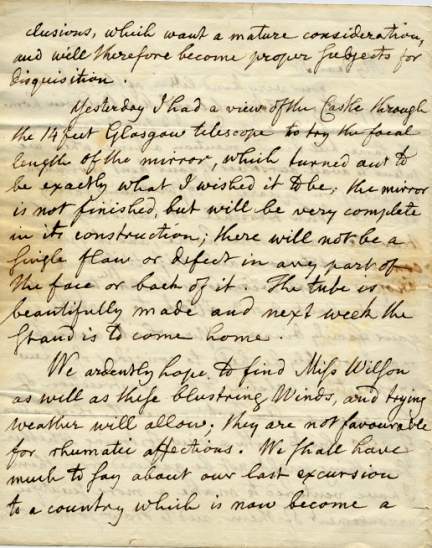
HERSCHEL, William (1738-1822). Musician and astronomer. Autograph Letter Signed to Dr [Patrick] Wilson (1743-1811, professor of practical astronomy, University of Glasgow, 1784-1799), 3 pages 4to with address-leaf, Slough, 19 October 1810. To a close friend and collaborator. Herschel invites himself to visit Wilson in a few days' time after the return from Cambridge of his wife and her sister, who had been delivering his son John [Frederick William] to the university, to 'partake of your family dinner' and to 'consider of a few propositions relating to the construction of the heavens'. He wishes to discuss his new arrangement of his observations of 2500 objects, and talks with enthusiasm of his trial of the 'Glasgow telescope', perhaps an instrument of his own construction. In 1783 Herschel and his sister Caroline (1750-1848, herself an astronomer), by observations made with his 20 foot telescope, had increased the number of known nebulae from about a hundred to 2500. Throughout his career as an astronomer, following his successful first life as a (very successful) musician, Herschel had made telescopes, some for his own use and others for purchasers at home and abroad. He personally had ground some 400 specula (metal mirrors), a field in which he was highly skilled. His great 40 foot telescope of 1784, which took three years in the construction, had been financed by George III on the encouragement of Sir Joseph Banks, then the president of the Royal Society. Herschel is perhaps more often remembered as the discoverer of the planet Uranus and the inventor of several astronomical terms, notably 'asteroid'. He always referred to his work, which largely differed from that of preceding astronomers in exploring the stars rather than the solar system, as observing 'the construction of the heavens'..
Patrick Wilson, the son of the astronomer Alexander Wilson, and himself professor of astronommy at Glasgow University from 1782 to 1799, came to live in London after his retirement and took part in experiments at Slough with Herschel, including a study into the sun's behaviour with a view to discovering any variations in its output of heat and light which might forecast good or bad harvests. In 1807 he was to confirm his friend's discovery of a bulging phenomenon in the southern polar region of Saturn, a discovery also confirmed by the fifteen-year-old John Frederick William Herschel. [No: 25752] The first image is of the second page only. The image links to a larger or more detailed version.
| |